
Main Article
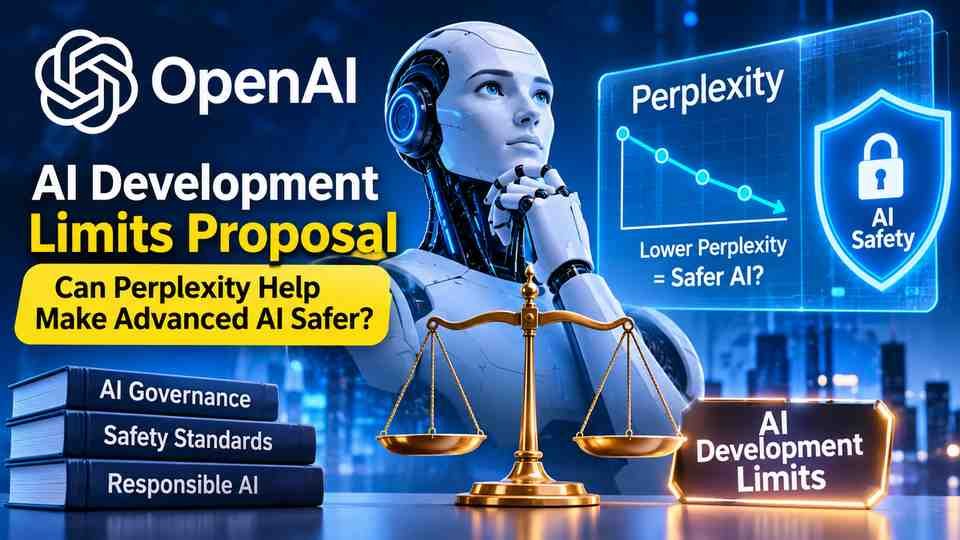
The debate over how quickly artificial intelligence should advance has entered a more technical phase. On November 22, 2026, OpenAI Chief Scientist Jakub Pachocki published a proposal arguing that AI developers should work toward shared limits on the development of increasingly capable models. A central part of the proposal is a measurement known as perplexity, which describes how effectively a language model predicts the next token in a sequence. Pachocki argues that tracking this measure could help the industry compare progress and create common safety thresholds.
The proposal addresses a difficult question: if AI capabilities are improving rapidly, how can researchers, companies and policymakers determine when development should pause or proceed more cautiously? The answer cannot depend only on a model’s performance in a single benchmark. It requires ways to measure underlying progress, understand emerging capabilities and verify that safeguards are keeping pace.
OpenAI’s proposal is significant because it seeks a shared technical reference point rather than relying entirely on individual companies’ internal assessments. It is not, however, a binding regulation or an industry agreement. Its practical impact will depend on whether other developers accept the measurement, whether comparisons can be made fairly and whether measurable safety milestones can be independently evaluated.
What Did OpenAI Propose?
In the post titled “Perplexity and Intelligence,” Pachocki argues that the progress of modern AI systems is closely connected to improvements in training models that predict data more effectively. He suggests that perplexity, or the closely related cross-entropy loss, could provide a useful way to track this progress across AI developers.
The proposal has two connected elements. First, AI companies would use a common measurement framework to make progress easier to compare. Second, developers would agree not to cross certain capability thresholds until they had achieved defined improvements in their ability to understand and monitor model behaviour. The intention is to connect the pace of development with evidence that safety and oversight systems are becoming more effective.
Pachocki also argues that AI could contribute to advances in AI training itself. If AI-assisted research accelerates model development, capability improvements could arrive faster than methods for evaluating and controlling those systems. The proposal therefore focuses not simply on whether a model is more capable, but on whether the industry can demonstrate that its understanding and monitoring capabilities are advancing at a sufficient rate.
What Is Perplexity in Artificial Intelligence?
Perplexity is a standard metric in language modelling. A language model estimates the probability of the next token based on the text that came before it. A token may be a word, part of a word, punctuation mark or another unit used by the model’s tokenizer. Perplexity summarizes how uncertain the model is when predicting the tokens in an evaluation dataset.
In general, a lower perplexity score means the model assigns higher probability to the observed tokens and is better at predicting that particular dataset. This makes perplexity useful for measuring a model’s predictive performance under controlled conditions. It is closely related to cross-entropy loss, a quantity commonly used during language-model training.
However, perplexity is not a complete measure of intelligence, reliability or safety. A model that predicts text well may still make factual errors, follow harmful instructions, expose sensitive information or fail at a complex real-world task. The score also depends on the dataset, language, domain and tokenization method used. Comparisons are most meaningful when the evaluation conditions are consistent and clearly disclosed.
Why Does OpenAI Want a Shared AI Progress Metric?
AI companies currently evaluate their systems using a range of internal and public tests. These may measure coding, mathematics, scientific reasoning, cybersecurity, instruction following, factual accuracy or other capabilities. Such evaluations are important, but they can become less informative as models improve, and different organizations may use different datasets, scoring methods and testing conditions.
A shared measurement could make it easier to discuss how quickly models are improving. It could also provide a common reference point for conversations about safety thresholds. If developers agree on a metric and publish enough information about how it is calculated, researchers and policymakers may have a clearer basis for comparing progress across organizations.
The benefit would not come from a number alone. A meaningful standard would need transparent datasets, reproducible methods, clear reporting rules and independent scrutiny. It would also need to account for differences between model architectures and tokenizers. Without these safeguards, a shared score could create an appearance of comparability without delivering a fair comparison.
Why Perplexity Cannot Be the Only Safety Benchmark
There are important limitations to using perplexity as a broad measure of AI capability. Predicting text accurately is related to language modelling performance, but it does not directly test every ability that matters for safety. A model’s performance on a held-out text dataset cannot, by itself, establish whether the model can plan harmful activity, exploit software vulnerabilities, manipulate users or behave reliably when deployed.
Research has also identified limits in perplexity-based comparisons. Different tokenization systems can divide the same text into different numbers and types of tokens, making raw scores difficult to compare across models. Academic work has further shown that conventional perplexity can be inadequate for assessing some long-context capabilities because averaging token-level performance may obscure errors involving particularly important parts of an input.
For these reasons, perplexity is best treated as one component of a wider evaluation programme. It can help track a specific dimension of model development, while task-based evaluations, adversarial testing, red-team exercises, security assessments, interpretability research and deployment monitoring examine other dimensions. A robust framework should explain what each test can and cannot establish.
How Could Common AI Development Limits Work?
A practical system would require more than a public statement of intent. Developers would first need to agree on what is being measured, how the metric is calculated and which datasets are appropriate. They would then need to establish thresholds that trigger additional scrutiny or a pause in capability increases. The exact thresholds and milestones would have to be negotiated and justified with evidence; they should not be assumed from the proposal itself.
The next step would be defining safety milestones. These might include demonstrated improvements in the ability to detect dangerous capabilities, monitor model behaviour, investigate unexpected actions and reduce risks before deployment. The milestones would need measurable acceptance criteria. Vague commitments to “improve safety” would be difficult to audit and would not provide a reliable basis for deciding when a development limit can be raised.
Independent evaluation would be essential. If each company measures its own progress and decides whether it has met its own safety conditions, the system could lack credibility. External researchers, standards bodies or qualified auditors could help assess methods and evidence, while protecting legitimate confidential information. Any governance arrangement would also need a way to report disagreements and revise standards as the technology changes.
What Does This Mean for OpenAI and the Wider AI Industry?
For OpenAI, the proposal presents a case for greater consistency in how frontier-model progress is described and assessed. The company’s decision to publish information about its pretraining progress may help other researchers examine the relationship between training metrics and emerging capabilities. At the same time, one company’s measurements cannot automatically become a universal industry standard.
For other AI developers, a shared framework could make it easier to coordinate expectations around increasingly capable models. It could also create additional costs. Companies may need to invest in compatible evaluation pipelines, external testing, documentation and monitoring systems. Smaller developers could find those requirements challenging unless standards are proportionate and accessible.
For policymakers, the proposal highlights a potential bridge between technical evaluation and governance. Regulation often needs clear definitions and verifiable criteria. A common measurement could support that work, but it would not replace legal requirements, public accountability or decisions about acceptable risk. Governments would still need to consider the broader social effects of AI deployment, including privacy, labour, competition and security.
Business Opportunities in Responsible AI Development
A stronger focus on AI evaluation and safety could create opportunities for businesses that help organizations assess, deploy and monitor AI systems. These opportunities are practical rather than guaranteed outcomes of OpenAI’s proposal.
AI testing and evaluation services could help developers measure model performance across defined tasks, languages and domains. Security specialists could provide red-team testing, vulnerability assessments and controlled simulations. Governance and compliance firms could support documentation, risk registers, audit preparation and internal accountability processes.
There may also be demand for monitoring tools that identify changes in model behaviour after deployment. Businesses using AI in customer support, finance, healthcare, education or enterprise software may need processes for tracking errors, escalating incidents and reviewing high-impact decisions. Data-quality providers and evaluation-platform developers could support these workflows.
Organizations should avoid treating a single score as proof that an AI product is safe. Buyers can instead ask vendors which datasets and benchmarks were used, whether tests cover the intended use case, how often evaluations are repeated, what human oversight exists and how incidents are handled. These questions are useful regardless of whether an industry-wide perplexity standard is eventually adopted.
Risks and Challenges of the Proposal
The first challenge is comparability. A metric is only useful across organizations if the measurement conditions are sufficiently consistent. Dataset selection, tokenization, model architecture and reporting practices can all affect results. A standard would need to specify these details and explain how to interpret exceptions.
The second challenge is metric gaming. Once a measurement becomes a target, developers may optimize for the score rather than the broader objective it is intended to represent. This risk can be reduced by combining multiple metrics, keeping some evaluations private, updating test sets and conducting independent assessments.
The third challenge is coordination. AI development is international, and companies operate under different commercial incentives and legal systems. Voluntary commitments may be difficult to enforce, especially if organizations believe competitors will continue developing more capable systems. A workable agreement would need credible participation, transparent procedures and incentives for compliance.
The fourth challenge is uncertainty about safety milestones. Researchers do not yet have a universally accepted test that proves a highly capable AI system is fully understood or controllable. Monitoring tools can miss unexpected behaviours, and test results may not predict every real-world deployment. Safety thresholds therefore need to be treated as evidence-based decision points, not guarantees of zero risk.
How Existing AI Risk Frameworks Fit In
OpenAI’s proposal enters a field where risk-management frameworks already exist. The US National Institute of Standards and Technology (NIST), for example, has published an AI Risk Management Framework and a Generative AI Profile. These resources help organizations identify, assess and manage risks across the AI lifecycle. They are not the same as a universal cap on model development, but they offer practical guidance for governance, measurement and accountability.
This distinction matters. A technical progress metric can help describe how a model is changing. A risk-management framework helps organizations decide how to identify and address possible harms in design, development and use. The two approaches can complement one another, but neither should be mistaken for a complete substitute for the other.
What Should Businesses and AI Users Watch Next?
The most important next signal will be whether other leading AI developers engage with the proposal and whether a common methodology begins to take shape. Watch for published definitions, shared evaluation datasets, reporting practices and specific criteria for raising or maintaining development thresholds.
It will also be important to see whether the proposed metric is combined with capability-specific testing. Cybersecurity, biological risk, autonomy, persuasion and other areas may require different evaluation methods. A broad training metric can provide context, but the risks of a particular system depend on what it can do, how it is accessed and where it is deployed.
For businesses adopting AI, the immediate lesson is to strengthen internal evaluation rather than wait for a global agreement. Document intended uses, test systems with realistic examples, monitor performance after launch and establish a process for human review and incident response. These measures can improve operational confidence even while industry standards remain under discussion.
Conclusion: Measuring AI Progress Must Go Hand in Hand With Safety
OpenAI Chief Scientist Jakub Pachocki’s proposal puts a measurable question at the centre of the AI safety debate: can developers agree on how to track progress and commit to limits until monitoring and understanding improve? Perplexity may contribute a useful signal because it measures how well a language model predicts data. But it cannot capture every capability or risk, and its use across different models requires careful standardization.
The proposal’s value will ultimately depend on implementation. Shared metrics need transparent methods, multiple forms of evaluation, independent scrutiny and clearly defined safety milestones. Businesses, researchers and policymakers should view the idea as an invitation to build stronger coordination—not as evidence that AI development has already been capped or that a single metric can guarantee safe systems.
Responsible AI progress will require technical measurement and practical governance to advance together. The industry’s challenge is not simply to build more capable systems, but to ensure that the ability to understand, test and manage those systems keeps pace.
Frequently Asked Questions
1. What limits did OpenAI propose for AI development?
OpenAI Chief Scientist Jakub Pachocki proposed that AI developers work toward common limits based on perplexity and other measurements. Developers would commit not to cross agreed thresholds until their ability to understand and monitor AI behaviour reaches defined milestones. The proposal is not, by itself, a binding industry rule.
2. What is perplexity in AI?
Perplexity is a language-model evaluation metric that measures how well a model predicts the next token in a sequence. Lower perplexity generally indicates better prediction on the dataset being tested. It does not independently measure overall intelligence, factual accuracy or safety.
3. Does lower perplexity mean an AI model is safer?
No. Lower perplexity indicates stronger predictive performance under particular evaluation conditions. Safety requires additional testing for harmful capabilities, reliability, security, misuse and behaviour in real-world settings.
4. Why does OpenAI want a shared AI benchmark?
A shared benchmark could help developers compare progress using more consistent methods. It may also support discussions about common development thresholds and the safety milestones required before those thresholds are raised.
5. Can perplexity be compared across all AI models?
Not automatically. Comparisons can be affected by differences in datasets, tokenization, model design and evaluation procedures. A meaningful shared standard would need to define consistent methods and disclose important limitations.
6. Will OpenAI’s proposal slow down AI development immediately?
There is no basis to conclude that development has immediately slowed. The proposal calls for industry coordination and common limits; its impact depends on whether other developers participate and agree on specific thresholds and milestones.
7. What role can businesses play in responsible AI development?
Businesses can test AI tools before deployment, monitor performance, document risks, maintain human oversight and establish incident-response processes. They can also ask vendors for clear evidence about evaluation methods and safeguards.
8. Is perplexity enough to measure artificial general intelligence?
No. Perplexity measures predictive performance on data, not every dimension of general intelligence. It may be one useful indicator among several, but broader claims require diverse capability evaluations and careful interpretation.