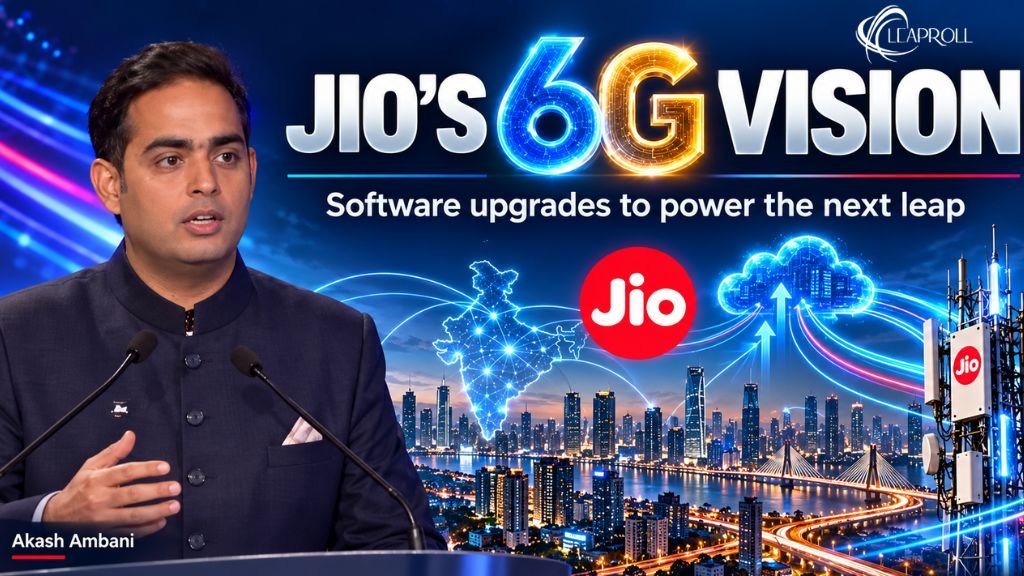
Jio plans to deliver 6G as a software upgrade on its existing network rather than build new infrastructure. Akash Ambani, Managing Director of Jio Platforms, announced the plan on 15 October 2026 at the company’s pre-IPO press conference in Mumbai. He said Jio’s towers, fibre, spectrum, and in-house technology stack are already prepared for the next generation of mobile networks.
The statement arrived just days before one of India’s biggest stock market listings. Naturally, it raises practical questions. Can a phone network really jump a generation through software? When will 6G actually reach Indian users? And what does this mean for the Jio Platforms IPO? This guide answers each one, using company statements, global standards timelines, and government policy.
Key Takeaways
| Announcement | Jio will roll out 6G as a software upgrade, not a new infrastructure build-out |
| Announced by | Akash Ambani, Managing Director, Jio Platforms |
| Date and venue | 15 October 2026, Jio Platforms IPO press conference, Mumbai |
| Network base | Over 3.6 lakh towers and more than 10 lakh route km of fibre |
| Customers | About 53 crore subscribers |
| Patents | 7,220 patents filed by Jio’s engineering team |
| Global 6G standard | First 3GPP specifications due early 2029; commercial launches expected around 2030 |
| Launch date in India | Not announced |
What Did Akash Ambani Say About Jio 6G?
Addressing investors and the media, Ambani described democratising technology as Jio’s first mission and said 6G was now on the company’s horizon. He then explained that Jio would “do 6G as a software upgrade rather than a new infrastructure build-out.”
He linked that confidence to the scale Jio already operates. According to Ambani, the network spans more than 3.6 lakh towers and over 10 lakh route kilometres of fibre, backed by the industry’s largest spectrum holdings. In addition, he said Jio carries over 60% of India’s data traffic, its users consume an average of 43.7 GB a month, and they get average download speeds of almost 200 Mbps.
Ambani also wants to take this technology abroad. He pointed to 7,220 patents filed by Jio engineers and said the company prefers to work as a managed-service partner for foreign telecom operators. In his view, this model would let Jio grow internationally without heavy capital spending of its own.
How Can 6G Arrive Through a Software Upgrade?
Older mobile upgrades meant new hardware almost everywhere. Operators replaced core equipment, swapped radios, and often bought fresh gear from foreign vendors. Jio believes its 5G design removes much of that burden.
Standalone 5G Built on Jio’s Own Stack
Jio launched 5G in October 2022 using standalone (SA) architecture, which runs independently of the older 4G network. At the time, Mukesh Ambani described Jio’s indigenously developed 5G stack as cloud-native and software-defined. As a result, many network functions run as software on general-purpose servers instead of fixed-purpose boxes.
Jio executives have also said the company is deploying its own software-defined radios. Because those radios are controlled by software, new features can be pushed through updates rather than truck rolls. Put simply, Jio owns the code, so it controls the pace of upgrades.
Why This Matters for Cost
Building a mobile network is enormously expensive. If Jio can reuse its towers, fibre, and core systems, it avoids repeating the capital spending that 4G and 5G demanded. That saving could, in turn, help keep data plans affordable, which has been Jio’s core strategy since its 2016 launch.
Reality Check: What a Software Upgrade Cannot Do
The plan is ambitious, yet some limits are worth understanding. Software can upgrade networks that are already software-driven. However, a few pieces of the 6G puzzle sit outside any single operator’s control.
First, the global 6G standard is not finished. The 3GPP body agreed in June 2026 that Release 21 will carry the first 6G specifications. Its first functional freeze is due in March 2027, and the final code freeze is scheduled for March 2029. Industry leaders such as Ericsson expect the first commercial 6G systems around 2030.
Second, 6G will likely use new spectrum. India’s Bharat 6G Alliance has flagged the 6 GHz mid-band, from 6425 to 7125 MHz, as a primary 6G band. Operators will need the government to allot such airwaves before a full launch. Where existing radios cannot work in a new band, some hardware additions may still be necessary.
Third, users will need 6G-ready phones. Smartphones depend on modem chips that support the new standard, and those chips will only arrive after the specifications are final. Therefore, a software-led network upgrade lowers Jio’s costs, but it does not make 6G instant.
Jio 6G Launch Date in India: What We Know
Jio has not announced a launch date for 6G. Based on the global standards timeline, commercial 6G is widely expected around 2030. India’s own plans point the same way. The government released its Bharat 6G Vision on 22 March 2023, aiming for India to be a frontline contributor to 6G by 2030.
Meanwhile, Jio’s near-term focus remains 5G. In June 2026, the company said it aims to move its entire subscriber base to 5G by 2030 while advancing India’s role in 6G standards. As of 31 March 2026, Jio had 268.5 million 5G users. Any date you see online for a Jio 6G launch is speculation until the company confirms it.
How Jio 6G Fits India’s National 6G Goals
India wants more than faster internet from 6G. The Bharat 6G Alliance, formed in July 2023, aims to make India a supplier of 6G technology and intellectual property. The government’s target is to secure at least 10% of global 6G patents by 2030. For comparison, India held roughly 1.5% of global 5G patents.
Jio’s patent filings and home-grown stack fit neatly into that goal. Ambani argued that Jio’s technology could help India export telecom technology instead of importing it. Still, success will depend on how many Indian contributions make it into the final global standards.
Why the Announcement Came Before the Jio Platforms IPO
The timing is no accident. Jio Platforms filed its Red Herring Prospectus on 14 October 2026, a day before the press conference. Its IPO opens on 21 October and closes on 23 October 2026, with a price band of Rs 1,065 to Rs 1,119 per share. The issue is a fresh sale of up to 27 crore shares, worth up to Rs 30,213 crore at the upper end, and listing is expected on 28 October.
Alongside 6G, Ambani laid out four growth drivers for investors:
| Growth driver | What Jio outlined |
| Mobility | 340 million potential users: 100 million first-time users and 240 million moving off 2G |
| Home broadband | Expand from 3 crore to 10 crore households |
| Enterprise | Services for businesses across India |
| Technology stack | License and operate its end-to-end stack for operators abroad |
A low-cost path to 6G strengthens the long-term story Jio is selling to investors. Even so, buyers should judge the IPO on its prospectus, not on a technology promise that is still years away.
Disclaimer: This article is for general information only. Jio’s 6G plans are forward-looking statements made by the company and may change with technology, standards, spectrum policy, and regulation. Nothing here is investment advice. Please read the official Jio Platforms Red Herring Prospectus and consult a SEBI-registered adviser before investing.
Final Thoughts
Jio’s plan to deliver 6G as a software upgrade shows how far its in-house technology has come since 2016. By owning a standalone, software-defined 5G stack, the company can upgrade much of its network without rebuilding it. However, global standards, new spectrum, and 6G-ready phones will still shape the real timeline, which points to around 2030. For now, the announcement is a clear signal of intent, and a strong talking point as Jio heads to the stock market.
FAQs About Jio 6G plans as a software upgrade
Yes, that is the plan. Akash Ambani said on 15 October 2026 that Jio will roll out 6G as a software upgrade on its existing network instead of building new infrastructure.
Jio has not announced a date. The first global 6G specifications are due in early 2029, so commercial 6G services are widely expected around 2030.
Most likely, yes. The network may upgrade through software, but your phone needs a modem chip that supports 6G, and such devices will follow the final standard.
Jio runs a standalone 5G network on its own cloud-native, software-defined technology stack. Because of that, many network functions can be upgraded through code.
The IPO opens on 21 October 2026 and closes on 23 October 2026, with a price band of Rs 1,065 to Rs 1,119 per share.