According to growing industry speculation, Google Veo 4 could arrive in 2026 as the company’s most advanced text-to-video model yet. While Google has not officially confirmed every rumored feature, the direction is clear: the next generation of AI video tools is aiming for longer clips, better visual quality, stronger consistency, and more professional creative control.
For content creators, marketers, filmmakers, and brands, that matters a lot. Today’s AI video tools still have obvious limits. Clips are often too short, characters can change from shot to shot, camera motion feels unpredictable, and “high resolution” sometimes means little more than upscaling. If Veo 4 delivers on expectations, it could solve many of the pain points that currently slow down AI-powered production.
Why Google Veo 4 Matters
AI video generation has already gone from novelty to serious creative tool. Brands use it for ads, social media teams use it for short-form content, and independent creators are experimenting with story-driven visuals that would have required real cameras, actors, and post-production teams just a few years ago.
But there is still a gap between “interesting demo” and “production-ready workflow.” That is exactly where Veo 4 could make the biggest impact. It is not just trying to make prettier clips. It is aiming to make AI video more usable in real-world creative work. That means fewer workarounds, less manual correction, and more control over the final result.
1. Longer AI Video Clips Could Change Everything
One of the biggest frustrations in AI video today is clip length. Many current tools generate only a few seconds at a time which becomes a problem when creators want to tell a story, build a scene, or produce a complete ad.
Google Veo 4 is expected to push generation length much further, possibly into the 20- to 30-second range. A single coherent clip of that length could be enough for:
- TikTok and Instagram Reels content
- YouTube Shorts storytelling
- product ads
- cinematic teasers
- music promo visuals
- branded social campaigns
Longer generation also reduces the need to stitch together multiple short clips. That process often creates mismatched lighting, inconsistent motion, and awkward scene transitions. If Veo 4 can produce smooth, continuous sequences in one pass, creators will save time and get better results.
2. Native 4K Video Could Raise the Quality Standard
Resolution is another area where AI video still has room to improve. Many platforms advertise high-definition or 4K output, but in practice, the video may be generated at a lower resolution and then upscaled afterward. That can work for some use cases, but it does not always hold up under close inspection.
One of the most exciting rumors around Google Veo 4 is the possibility of native 4K generation. If that happens, it would be a serious advantage.
True native 4K could make Veo 4 especially attractive for:
- professional marketing teams
- stock footage creators
- agencies producing campaign visuals
- trailer editors
- digital signage content
- premium brand storytelling
Google’s infrastructure gives it a real chance to compete at this level.
3. Character Consistency May Finally Become Practical
Anyone who has worked with AI video knows the problem. You create a character in one shot, then in the next shot the face changes, the hairstyle shifts, or the clothing suddenly looks different. That breaks immersion immediately.
Google Veo 4 is expected to improve consistency by allowing users to guide identity through reference images. In practical terms, this could mean uploading a few photos of a person, model, or product so the system can keep that visual identity stable across scenes.
If Google gets this right, it would unlock major new use cases:
- short films with recurring characters
- branded mascot campaigns
- product videos with consistent design
- influencer-style content without visual drift
- serialized storytelling across multiple scenes
This feature would also be valuable beyond people. Object consistency matters in advertising too. A shoe, bottle, car, or device needs to look the same from shot to shot. For commercial content, that kind of reliability is essential.
4. Smarter Audio Could Make AI Video Feel More Complete
Video is only half the experience. Sound is what gives motion content depth, realism, and emotional impact. Google has already shown interest in synchronized audio generation, and Veo 4 may go even further. Expectations suggest more advanced audio layers, with separate elements such as dialogue, environmental ambience, and sound effects generated in a more flexible way.
That would be a big deal for creators. Instead of receiving one flattened audio track, users could potentially work with more editable sound components. This would make AI video much easier to polish for different platforms and audiences.
Imagine generating a city street scene and getting:
- background traffic ambience
- footsteps
- passing voices
- focused character dialogue
- movement-based sound positioning
If Veo 4 introduces this kind of layered or spatially aware audio, it could move AI video much closer to professional post-production workflows.
5. Better Camera Control Could Turn Prompts Into Real Direction
One reason many filmmakers remain cautious about AI video is that camera movement can still feel unpredictable. You may ask for a subtle cinematic move and get something exaggerated, unstable, or simply unrelated to the prompt.
Google Veo 4 is rumored to improve this by supporting more direct and film-friendly camera instructions. That could include commands such as:
- slow dolly in
- overhead crane shot
- handheld chase movement
- orbit around subject
- rack focus between foreground and background
This kind of control matters because video is not just about what appears in the frame. It is also about how the viewer experiences motion, perspective, and emphasis.
When Could Google Veo 4 Launch?
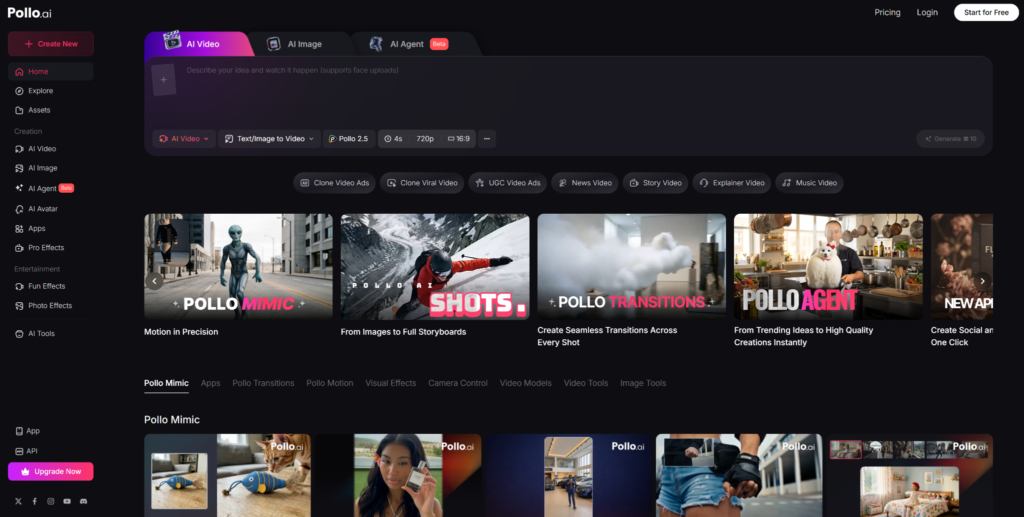
Google has not fully confirmed the public release timeline. However, industry speculation points to a possible unveiling in 2026, with attention building around a spring launch window. Once Veo 4 goes live, it will be available directly on Pollo AI, a leading content creator APP for AI video generation.
As with any pre-release reporting, it is smart to stay cautious. Features can change, launch dates can shift, and early leaks do not always tell the full story. Still, the momentum around Veo 4 suggests that Google is preparing something significant for the next phase of AI video.
Final Thoughts
Google Veo 4 could become one of the most important AI video releases of 2026. The reason is not just hype. It is the possibility that Google may finally address the practical problems that have held AI video back: short clip limits, weak consistency, uncertain camera behavior, and output quality that falls short of professional needs.
For now, creators should watch closely. The next era of AI video may be much closer than it seems, and Google Veo 4 could be one of the tools that defines it.