
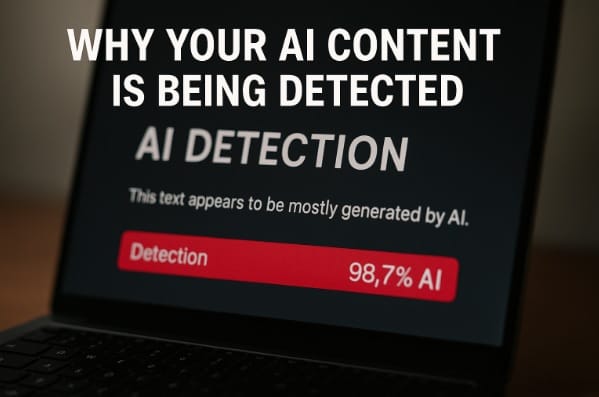
All of us, students, and bloggers, have all been to that point in our lives where we copy that perfect, smooth paragraph into GPTZero, Turnitin, or some other AI detector and watch it pop bright red. The text was fine. The grammar was flawless. The explanation was clear. And yet the detector, with its unwavering confidence, declared that the writing was not human.
The feeling of confusion after that is real. AI is getting better. Shouldn’t detectors be less certain, not more? The truth is something else entirely. Modern AI models are powerful. They are trained on huge datasets, and they favor safe, likely sentences. That means they produce writing which is smoother on the surface than humans are. AI detects patterns, not “ChatGPT.” And those patterns don’t go away, even just in high-quality AI writing.
Knowing why AI writing is detectable — and how to instantly fix it — is a practical skill for writers. It isn’t about “hiding” the fact that we used AI. It’s about making writing read alive, specific, and real. It’s about producing prose that reads like something a human actually sat down to write, rather than something put together by probability.
How AI Detectors Actually Identify Machine-Generated Text
AI detectors aren’t looking for hidden markers or metadata. They’re looking for statistical signatures. One of those measurements is perplexity, which reflects how predictable we think the next word in a sentence will be. AI-generated text is usually low-perplexity, because language models prefer the safe, likely word. A sentence like “This is an important issue that requires careful consideration” is smooth — but almost too smooth. It’s following the same patterns that keep popping up in model outputs.
Another measurement is burstiness, which reflects sentence-length variation. Humans naturally vary between sharp, brief lines and longer, more complex sentences. AI tends to sit comfortably in the middle, creating tidy, well-structured paragraphs made up of medium-length sentences. That evenness creates a rhythm that an AI detector picks up on.
The science of stylometry, or the linguistic fingerprint, shows how similar are the transitions, the logical progressions, and the abstract vocabulary that AI uses regardless of the topic. Even when the writing feels right, it’s just too predictably right, and AI detectors recognize that pattern way more reliably than most people think.
The Hidden Patterns That Make AI Text Detectable
One of the clearest indicators of AI writing is the even cadence. Many language models seem to be stuck in a narrow band between 16 and 22 words per sentence, which gives the paragraph the feel of being cut from a longer, matching piece. As humans, we rarely stay in that sweet spot. We drift into longer thoughts, we cut ourselves off, we sidestep. We compress our ideas into a short, emphatic, single line. It’s that natural unevenness that is missing from the model.
The vocabulary used is another giveaway. AI often uses generic, neutral words like “significant,” “crucial,” “additionally,” and so on. Even when those words fit the context, they accumulate into a pattern that reads like academic filler. A human writer, on the other hand, might be slipping into a slightly more specific phrasing, or slipping in some small idiosyncratic marker of their own voice.
AI text is also often generalized. It describes ideas accurately, but from a distance. It lacks the specific, grounded details that human writers tend to slip in automatically. A human student writing about social influence might bring up a conversation in the classroom or with their friend about a current news story, or a scene in a movie. An AI, on the other hand, will stay in the abstract.
Finally, the structure of the paragraph shows the machine. It’s usually a classic intro paragraph: introduce the idea, elaborate it, move to the next, conclude. It’s logically clean, but the logic is predictable. That’s what detectors are looking for.
Why Paraphrasing Tools Don’t Fix AI Detection
Many writers try to dodge detection by running their AI text through paraphrasers, hoping a few synonym swaps will do the trick. But detection tools aren’t catching the vocabulary; they’re catching the underlying structure.
Paraphrasing tools are usually just swapping terms for their close synonyms, which means the rhythm, sentence structure, and logical structure remain almost the same. That means detectors still pick up upon the same statistical signals, even though the words may be different.
The real difference comes when the structure gets rewritten. That’s what tools like GPTHumanizer AI do. They dive deeper, reworking the structure of the writing. They change the pace, the flow of the narrative, the rhetorical structure of the paragraph. Objectively, they produce a text that is more varied in sentence length, more human-like in rhythm. They’re not “tricking” detectors. They’re fixing the problem: The writing is no longer machine-like.
What Humanized Writing Actually Looks Like
Humanized AI content feels alive because it bends structure instead of following it. A human writer moves from idea to idea with personality. Some sentences stretch; others compress. Some sentences have a micro-detail that AI rarely adds to the sentence because it’s not mathematically needed for coherence.
Humanized writing often has a more intentional choice of words, as if the writer had a moment to consider the tone instead of letting the model default to an academic register. Humanized writing also has cause-and-effect explanations, specific angles, and real-world grounding.
To see the contrast more clearly, the table below summarizes the differences:
| Feature | AI-Like Text | Humanized Text |
| Rhythm | Even, predictable | Varied and dynamic |
| Vocabulary | Generic, repetitive | Contextual and personal |
| Structure | Template-like | Flexible and organic |
| Burstiness | Low | Higher, more human-like |
| Detection Risk | High | Lower |
| Reader Engagement | Flat | More compelling |
These aren’t superficial edits. They reflect deeper structural changes that move the writing away from the mechanical patterns that detectors pick up on.
How to Fix AI Detection Instantly
The fastest way to reduce detectability is to rewrite the structure, instead of patching up the synonym box. One effective way to do that is to deliberately vary sentence length: let one idea stretch into a longer sentence, then follow it with a shorter one that cuts to the point. That disrupts the statistical smoothness that detectors look for.
Another thing that helps is adding concrete examples. Instead of describing an abstract idea, tie it to a quick scenario or observation. When you add human reasoning, narrative flow, and little personal markers, the text naturally diverges from the AI pattern.
For writers who want an automated approach, AI humanizer (e.g GPTHumanier AI) delve deep into the structure, rearranging the sentences, changing the pace, and introducing natural variation. The resulting text reflects the unpredictability of human writing. The goal isn’t to trick detectors. The goal is to write in a way that sounds more natural.
Example Rewrite: AI-Like vs Human-Like
AI-like version:
“Social influence is an important concept — that affects people’s behavior in many contexts. Individuals often change their actions to align with group expectations, and this can lead to positive or negative outcomes depending on the situation.”
”Humanized version:
“Social influence shows up everywhere, sometimes in ways we barely notice. Think about the moment you adjust your opinion because everyone else in the room seems certain. That small shift may feel harmless, but it reveals how quickly we shape our behavior to fit the people around us. The outcomes can be helpful or, in some cases, quietly damaging.”
The meaning is the same, but the rhythm, specificity, and narrative presence feel distinctly human.
Conclusion: The Future of AI Writing Is About Sounding Human, Not About Tricks
AI writing is now a normal part of academic work, blogging, and content creation. The question isn’t whether you use AI, but whether the final article sounds natural. Detectors will keep getting better, but so will the tools and techniques that help writers reshape their drafts into authentic, reader-friendly prose.
Humanizing writing isn’t about exploiting a loophole. It’s an upgrade. When your paragraphs reflect the natural irregularities, the insights, and the texture of human expression, they resonate more with readers, and detectors simply recognize what’s written: Human writing.
You can also read about this:
Top Quality Drones in Singapore: A Clear Guide to Features, Prices and Smart Buying Choices

