
By the year 2025, marketing was no longer based upon interruption-driven advertising, rather, it was experience-based storytelling. The buyers became more choosy with what to watch, click, and share and brands had to re-evaluate the way they communicate with audiences. The most winning brands did not depend on a greater voice or increased advertising. Instead, they combined artificial intelligence, augmented reality, interactivity, and cultural relevance to develop campaigns that were personal and memorable. Such initiatives reestablished the brand-to-individual relationship in a saturated digital and physical environment. The article will discuss Recent Innovative Marketing Campaigns Examples 2025 and what lessons marketers can learn in future marketing campaigns, even in rapidly emerging markets such as India.
Why Innovative Brand Marketing Became Essential in 2025?
Due to digital fatigue, it reached an all-time high in 2025. Millions of brand messages reach consumers in social media, apps, websites, and the outdoors everyday. Conventional advertisements were frequently skipped, silenced or disregarded. Innovation shifted focus less on utilizing new devices to more on creating meaningful contacts. Successful brands were relevant as opposed to reach. They made opportunities that embraced engagement rather than imposing promotions. Technology (AI and AR) served as an aiding factor, assisting brands in providing utility, personalization and immersion. The best campaigns were those that matched directly with daily life experiences, emotions and cultural events and it was a way of marketing rather than advertisement.
Recent Innovative Marketing Campaigns Examples 2025
Relatable AI Brand Campaign of ChatGPT
ChatGPT delivered one of the most powerful recent innovative marketing campaigns examples of 2025. The brand did not showcase artificial intelligence as something from the future or complex, but did highlight the aspect of solving problems in our daily lives. The campaign featured real-life examples where individuals utilized AI to do basic activities like vacation planning, meals, work organization and studying. These narratives were to be cozy and human, showing how AI could relax and save on time. The technology did not feel threatful because short-form videos were capturing the moments of revelation and relief. The emotive narrative style worked. The rate of social sharing grew fast with users labeling friends and providing themselves with their own experiences. The number of active users daily increased drastically within some weeks of the campaign launch. The campaign demonstrated that, with technology being positioned as a supportive tool rather than disruptive power, it becomes easily adopted.
Axe’s Interactive Bus Stop Experience
Axe, a personal care brand, installed a bus stop as an interactive arcade, making it one of the most radical out-of-home marketing campaigns in 2025.
As an alternative to the fixed posters, the brand deployed massive screens that enabled commuters to play branded games as they were waiting to board the public transport. It was an entertaining moment that turned a dull one into a video and made people record it and share it through social media. The advertisement was predominantly organic and not paid.
This strategy was a mix of physical and digital marketing. The mock execution fit very well with the audacious brand image of Axe and appealed to the younger audience greatly. Areas where the activation was carried out registered higher sales, and this shows that with the proper implementation of experiential marketing, it can directly influence revenue.
LEGO’s “Build the Future” AI Co-Creation Campaign
LEGO has shown how innovation can build the brand heritage and not overtake it. LEGO in its 2025 campaign challenged children to create futuristic toys with the help of AI-driven, online products.
People were able to brainstorm, design products, and post their products on the internet. This transformed passive consumers to proactive producers of children. Parents were also willing since the campaign did not involve passive screen time but it involved creativity and learning.
The level of engagement was very high and the sales of educational products were boosted significantly throughout the campaign. LEGO demonstrated that co-creation creates long-term loyalty and emotional attachment by integrating AI with its traditional philosophy of imagination and play.
Coca-Cola’s AR-Driven “Real Magic” Campaign
In 2025, global drinks giant Coca-Cola proceeded with its tradition of emotional branding by launching an augmented reality-based campaign. The Real Magic initiative changed product packaging to interactive experiences. This was done by scanning bottles and cans by consumers in order to access digital stories, games, and personalized content. This strategy linked the real purchase with digital experiences that enabled immersion beyond the point of purchase. The campaign re-invigorated the legendary Share a Coke theme by incorporating the use of QR codes which allowed the personalization of video messages and memes. Such a combination of nostalgia and technology appealed to Gen Z audiences. The level of engagement and the social sharing of websites raised considerably, which strengthened the authority of AR in the process of transforming offline and online brand experiences.
Bumble’s Authentic Love Storytelling
Dating app Bumble responded to the dating app fatigue by launching a campaign centered around genuine experience and not desire. Rather than actors or pre-written advertisements, Bumble featured real couples who had found their partners on the application. These tales were distributed through online platforms and combined with the enhancement of security measures, including photo verification and dating centers that were community-based. The campaign was focus on trust, respect, and authentic relationships.
Focusing on the actual user experiences, Bumble humanized its brand and stood out against the competitive market. The number of app downloads and the number of people engaging in social platforms rose during the campaign time. The campaign reaffirmed that real life stories are better than super polished advertisements.
Billie’s Sensory Scratch-and-Sniff Posters
One of the most discussed sensory marketing campaigns of 2025 was provided by personal care brand Billie.
Billie also use armpits in scratch-and-sniff posters positioned in New York City to advertise its deodorant. The execution was humorous and unexpected, as it immediately attracted attention and provoked the people to engage with the ads. Social media videos of reactions went viral, creating huge organic impressions.
The campaign has shown the strength of multisensory advertising. The deodorant line sales shot up after the activation, which indicates that the ambitious creativity and physical contact can cut through the gunk of advertising.
Uber’s “My Thanksgiving Vibe” AR Campaign
Uber, a ride-hailing service, incorporated AR to incorporate entertainment into utility over the holiday season. Personalized filters were designed in the form of AR lenses in the campaign My Thanksgiving Vibe which was sponsored by Snapchat and personalized according to the habits and travel patterns of the users. Although it was charming and shareable, the experience quietly prompted the users to reserve rides at the best times. The campaign delivered high levels of engagement and booking intent, proving the potential of AR to contribute to the actual objective of any business under the condition of harmonization with the needs of people. It demonstrated that the combination of seasonal relevance and personalization can facilitate significant outcomes.
Rare Beauty’s Fragrance Sampling Billboards
Rare Beauty, a beauty brand, has approached the issue of promoting fragrance in an online-only world by a creative outdoor campaign.
The brand has opened scratch-and-sniff billboards in the major cities alongside QR codes which allowed users to request free samples online. This smooth integration of the physical experience and digital conversion made outdoor advertising a performance channel.
The campaign achieved a viral buzz on social media and generated instant sales. It emphasized the use of sensory engagement along with technology as a way of resolving traditional marketing issues in innovative solutions.
Key Trends Behind Recent Innovative Marketing Campaigns
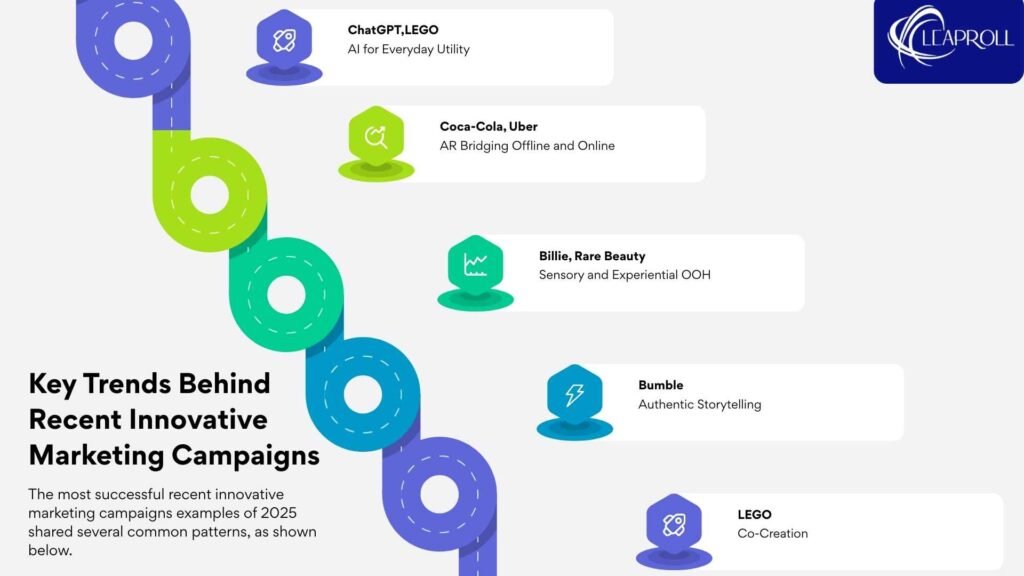
The most successful recent innovative marketing campaigns examples of 2025 shared several common patterns, as shown below.
| Trend | Campaign Examples | Business Impact |
|---|---|---|
| AI for Everyday Utility | ChatGPT, LEGO | Higher adoption and participation |
| AR Bridging Offline and Online | Coca-Cola, Uber | Increased dwell time and conversions |
| Sensory and Experiential OOH | Billie, Rare Beauty | Viral reach and sales growth |
| Authentic Storytelling | Bumble | Trust and user engagement |
| Co-Creation | LEGO | Community building and loyalty |
How These Campaigns Can Inspire Indian Brands
Experiential marketing and tech-based marketing have enormous prospects in Indian markets particularly during festivals, entertainment, and sports. By refining these global concepts to local culture, the brands can harness such global concepts. Emotional engagement can be motivated by festival-based AR experiences during Diwali or Holi. Integrations are possible through reality shows with QR codes that will stimulate participation. Auto and technology brands can provide AR-powered virtual demonstrations, whereas finance-oriented applications can utilize AI to customize festive deals. It does not matter much to copy campaigns but rather to implement the principles of relevance, participation, and utility.
Future Outlook of Innovative Marketing
Innovation will prioritise constructing enduring systems, as 2026-onwards brands will look to avoid single-purpose gimmicks by developing systems over a long duration. AI is going to be more personalized and optimized, and AR and immersive technology are still going to move the boundary between the physical and the digital. Ethical use of technology and purpose-driven storytelling will gain more significance as consumers insist on transparency. The 2025 campaigns demonstrate that innovation is not about choice anymore. The Brands, which create purposeful, human-centered experiences will keep gaining attention, trust, and loyalty in an ever-growing competitive environment.
Conclusion
As the examples of successful recent innovative marketing campaigns in 2025 demonstrate clearly, in modern marketing, it is no longer about pushing messages but about providing meaningful experiences. Those brands that integrated technology and human understanding were capable of getting through digital fatigue and gaining authentic attention. It was the AI that made daily life easier, AR that linked physical items with the digital narrative, and the ideas of sensory outdoor campaigns that aurous curiosity, and innovation was the most effective when it seemed useful, emotional, and culturally meaningful. Such movements demonstrate that people react better to authenticity, participation, and personalization than to traditional advertisements.
FAQ’s
The recent examples of innovative marketing campaigns include brand campaigns based on new ideas, technologies, or formats like AI, AR, interactivity, and experience marketing activities to involve audiences in creative and meaningful ways.
The 2025 campaigns were unique as they were built around user engagement, personal anecdotal content, and practical use rather than conventional marketing messages.
AI was use to deliver personalized content to brands, support users in daily activities, facilitate co-creation, and improve the performance of a campaign in real time.
AR bridged real-life goods, packaging, and outdoor advertisements and virtual immersive experiences, which enhanced engagement and conversion.
Indian brands can replicate these by localising campaigns to festivals, sports and entertainment and by applying AI and AR, making these campaigns interactive and culturally relevant.
You can also Read About it: