
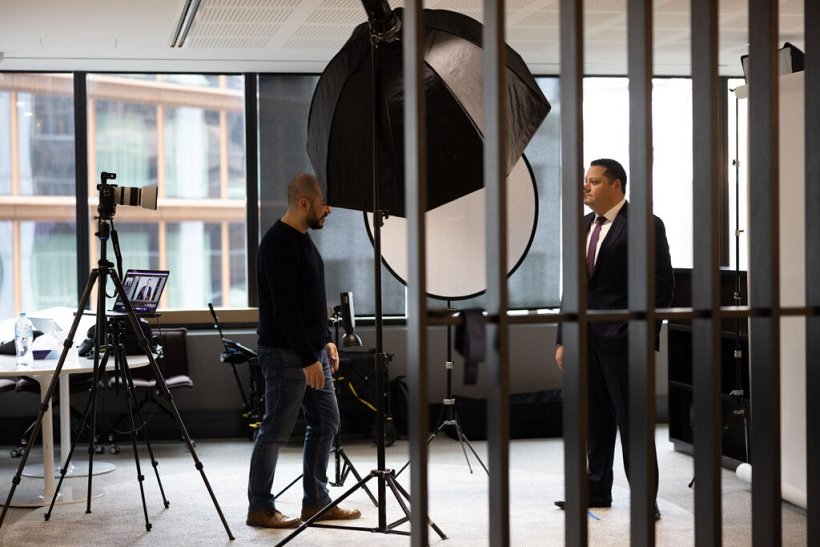
A company’s visual identity is often the first handshake it offers to the world. Before a client reads a mission statement or a potential hire reviews a job description, they see an image. That split-second visual processing determines whether an organization appears competent, approachable, and trustworthy—or outdated and disorganized.
Corporate photography is far more than pointing a camera at a CEO in a suit. It is a strategic exercise in brand management. Professional photographers serve as visual architects, constructing an image of authority and reliability through a complex blend of technical mastery and psychological insight. They must navigate the sterile lighting of boardrooms, the awkwardness of camera-shy executives, and the rigid constraints of brand guidelines to produce assets that feel authentic yet polished.
Achieving this balance requires specific skills that go far beyond owning a high-end camera. It involves understanding the geometry of faces, the physics of light, and the psychology of business. The following analysis explores exactly how industry professionals execute this task, breaking down the technical and interpersonal strategies used to capture professionalism.
Why is visual consistency crucial for corporate branding?
Consistency is the bedrock of trust. When a company presents a unified visual front, it signals organization, attention to detail, and stability. Corporate photographers achieve this by establishing a specific “visual language” before the first shutter click.
This process often begins with a “mood board” or a style guide review. Photographers determine whether the brand is traditional and authoritative (often requiring darker backgrounds, dramatic lighting, and formal attire) or modern and innovative (requiring bright, airy environments, natural light, and casual posture).
If a company’s “About Us” page features a mix of high-resolution studio shots, grainy selfies, and poorly lit outdoor photos, the subconscious message to the viewer is one of fragmentation. A professional photographer ensures that the lighting ratios, color grading, and background choices remain uniform across the entire team, regardless of whether the photos are taken on different days or even in different office locations. This uniformity transforms a group of individuals into a cohesive unit.
What equipment distinguishes a pro from an amateur?
While a great eye is essential, the “professional look” is often a result of specific optical physics that smartphone cameras and entry-level DSLRs cannot replicate. Corporate photographers utilize specific gear designed to flatter the human form and control the environment.
Lens Selection and Focal Length
The most critical tool in capturing a professional portrait is the lens. Professionals typically avoid wide-angle lenses (anything below 50mm) for portraits because they distort facial features, making the nose appear larger and the face wider. Instead, they rely on telephoto lenses, typically in the 85mm to 135mm range. These lenses compress the background and facial features, creating a slimming, flattering effect that looks natural to the human eye.
Sensor Size and Depth of Field
Professional full-frame sensors allow for a shallower depth of field. This allows the photographer to keep the subject’s eyes razor-sharp while blurring the background into a soft, non-distracting wash of color (bokeh). This optical separation steers the viewer’s attention strictly to the subject, a hallmark of high-end corporate imagery.
Tethering Capabilities
In a high-stakes corporate shoot, photographers often shoot “tethered,” meaning the camera is connected via cable to a laptop. This allows the art director or the subject to view the images on a large screen instantly. It ensures that attire issues, stray hairs, or posture problems are corrected in real-time, guaranteeing a usable final product.
How does lighting dictate the mood of a corporate portrait?
Light is the language of photography. In a corporate context, lighting does not just illuminate the subject; it defines their character. Professionals use distinct lighting patterns to convey different corporate values.
Broad vs. Short Lighting
To make a subject look more powerful or approachable, photographers manipulate the direction of light. “Short lighting” (where the side of the face turned away from the camera gets the main light) creates shadows on the larger side of the face, which is slimming and adds a sense of drama and strength. “Broad lighting” illuminates the side of the face facing the camera, which can widen a narrow face and create a more open, friendly appearance.
The “Catchlight”
If you look closely at a professional headshot, you will see a small white reflection in the subject’s eyes. This is called a catchlight. Without it, eyes look dead and flat. Photographers intentionally place light sources to ensure this spark exists, bringing life and intelligence to the subject’s expression.
Color Temperature Control
Office environments are notorious for “mixed lighting”—the clash between cool blue daylight coming from windows and warm orange light from overhead tungsten bulbs. This mixture creates unflattering skin tones. A professional overrides ambient light using strobes (flash) balanced to a specific color temperature (usually 5600 Kelvin), ensuring skin tones look healthy and natural rather than sickly green or orange.
What psychological techniques help subjects relax?
Most corporate executives are comfortable in a boardroom but terrified in front of a lens. Tension manifests physically: shoulders hunch, jaws clench, and smiles become rigid. A stiff subject never looks professional; they look uncomfortable. Therefore, a photographer’s ability to direct is just as important as their ability to light.
The Mirror Technique
Photographers often mirror the body language they want to see. If they want the subject to lean in and look engaged, the photographer will lean in. If they want a genuine smile, they stop saying “cheese” and instead engage in conversation, waiting for a micro-expression of genuine amusement to capture the shutter.
Jawline and Posture Coaching
To capture a sharp, professional jawline, photographers use a classic instruction: “push your forehead out and down.” It feels unnatural to the subject, but to the camera, it stretches the skin of the neck and defines the jaw, instantly shedding imaginary weight and projecting fitness and alertness.
Hand Placement
“What do I do with my hands?” is the most common question on set. Hands can convey anxiety if they are fidgeting. Professionals provide clear directives—thumbs in pockets, arms crossed loosely, or hands resting on a desk—to anchor the subject and project confidence.
Why is “environmental” photography gaining popularity?
For decades, the standard corporate photo was a head-and-shoulders shot against a mottled grey background. While this style persists, there is a massive shift toward “environmental portraits.” This style captures the subject in their natural work element—an architect at a drafting table, a CEO in a glass-walled conference room, or a developer in a collaborative workspace.
This approach provides context. It tells a story about what the person does, not just what they look like. It feels more transparent and authentic, qualities that modern consumers value highly. However, these shots are technically difficult. The photographer must balance the exposure of the subject with the exposure of the background, often requiring complex portable lighting setups to ensure the person isn’t a silhouette against a bright office window.
How does retouching balance reality and perfection?
Post-production is the final step in securing a professional aesthetic. However, there is a fine ethical line in corporate photography. The goal is to present the “best day” version of the subject, not a plasticized fantasy.
Temporary vs. Permanent Features
The golden rule of professional retouching is: remove temporary blemishes, keep permanent features. A pimple, a razor nick, or a stray hair can be removed because they are temporary distractions. A scar, a mole, or deep laugh lines are part of the person’s identity. Removing them can make the subject look waxen and untrustworthy.
Color Grading for Brand Alignment
Retouching also involves color grading. A tech startup might want cool blues and clean whites to signify hygiene and precision. A heritage law firm might prefer warmer tones and rich blacks to signify tradition and stability. Photographers adjust the color palette in post-production to subtly reinforce these brand attributes.
What is the ROI of professional corporate photography?
Investing in high-quality photography is often viewed as a marketing expense, but it is effectively an asset purchase. The return on investment (ROI) manifests in several key business metrics.
Enhanced Recruitment
Top talent wants to work for successful, modern companies. A “Meet the Team” page filled with high-quality, vibrant images suggests a company culture that values its people and invests in quality. It humanizes the corporation, making it an attractive destination for job seekers.
Increased Engagement
Visual data is processed 60,000 times faster than text. On platforms like LinkedIn, posts with images receive significantly higher engagement rates. When those images are professional quality, they stop the scroll. High-quality imagery increases the perceived value of the services offered. If a consultant looks polished and sharp, the assumption is that their advice will be polished and sharp.
Media Readiness
When a company wins an award, launches a product, or faces a PR crisis, having a library of high-resolution, approved images ready for the press allows the company to control the narrative. Media outlets are more likely to run a story if they are provided with excellent visual assets.
The Final Frame
Corporate photography is a specialized discipline that merges technical precision with soft skills. It is not merely about documenting who works at a company; it is about defining who the company is.
By controlling light, composition, and expression, photographers translate abstract concepts like “integrity” and “innovation” into tangible pixels. In an increasingly digital landscape, where face-to-face meetings are rare, these images often do the heavy lifting of building business relationships. A professional photo does not just capture a face; it captures a reputation.
You can also Read About it:
How a Long Island Lawyer Handling Paternity Disputes Protects Your Parental Rights