
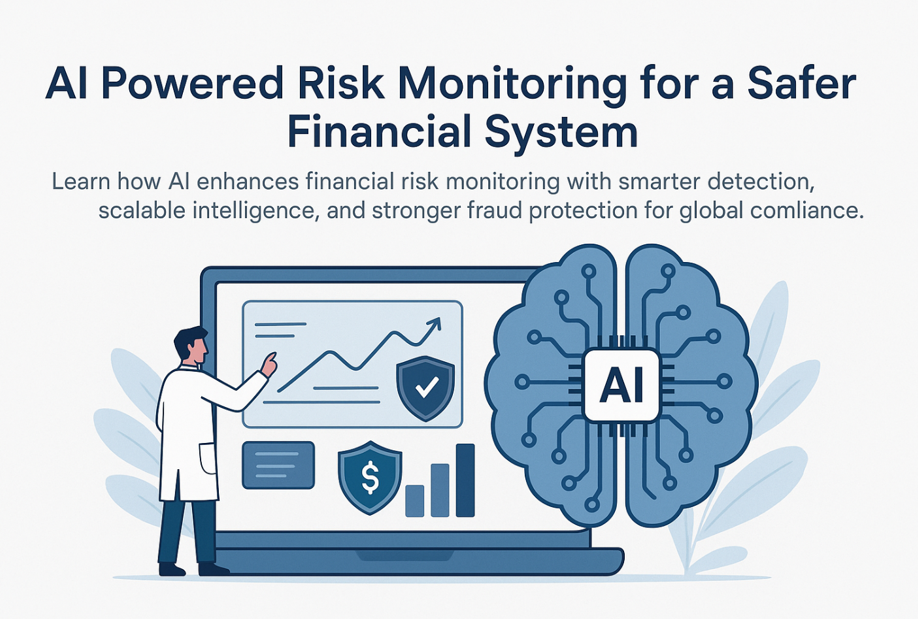
Financial crime continues to escalate as digital payments expand. The United Nations Office on Drugs and Crime estimates that between 800 billion and 2 trillion dollars is laundered worldwide each year. Criminal organizations use synthetic identities, fast payment channels, and cross border systems to bypass outdated controls. Traditional risk models were not built for this level of complexity or speed.
Artificial intelligence has become a crucial tool in this global fight. It supports compliance teams with faster analysis, smarter alerting, and risk scores that adapt to new financial behaviors. Human specialists remain in control, but AI expands what is possible to detect and prevent. Flagright explores how AI plays a major role in redefining financial risk assessment with automated detection capabilities, real time insights, and stronger resilience against fraud. Their breakdown of this shift in compliance is available here.
AI does not replace analysts. It improves their results and gives users safer access to financial services.
Why AI Has Become Critical in Risk Monitoring
Financial risk management used to rely on rules, thresholds, and historical performance. Those methods still offer value, but they fail to recognize new typologies or sudden changes in behavior.
Key pressures driving AI adoption:
- Transaction volumes are too large for manual review
- Fraud patterns evolve weekly, not yearly
- Regulators expect timely, accurate risk classifications
- Customers want fast onboarding without friction
- Digital identities can be manipulated with low effort
Institutions that rely only on static rules face higher operational costs and more false positives. AI improves risk monitoring by learning from real outcomes and adjusting when criminals change tactics.
How AI Strengthens Risk Decisions Across the Customer Lifecycle
AI touches each compliance stage. When models communicate across these stages, detection improves dramatically.
Onboarding and Identity Assurance
- AI evaluates ID document authenticity
- Device fingerprinting detects risky login patterns
- Behavioral analytics flags suspicious signups
- Knowledge checks adapt to a user’s past activity
A 2023 McKinsey analysis found that financial institutions using AI for onboarding cut fraudulent account creation by up to 30 percent while reducing time to approve new users.
Continuous KYC Enhancement
Customer profiles cannot remain static. AI updates attributes in real time so monitoring reflects true behavior.
Signals include:
- New merchant categories
- Out-of-pattern locations
- Sudden changes in income or balance
- Repeat transactions with high risk partners
Continuous KYC gives analysts better visibility and identifies risk well before a SAR filing becomes necessary.
Transaction Monitoring and Alert Intelligence
Instead of simple rules, models evaluate context:
- Who is sending money
- Why they typically transact
- Where funds originate
- Frequency and timing of movement
Machine learning produces risk scores that offer meaningful differences. Investigators spend less time on low value alerts.
AI Accelerates Fraud Prevention
Fraud detection often happens within seconds. AI enables a real time defense against:
- Account takeovers
- Card not present fraud
- Money mule recruitment
- Data breach exploitation
Key techniques powering faster fraud blocking
Pattern recognition
The system learns what looks normal for each account and flags deviations.
Graph analysis
Relationships between entities are mapped to expose criminal networks.
Natural language understanding
Phishing attempts and suspicious communications can trigger investigation.
Predictive detection
Models forecast threats before they escalate across multiple victims.
When paired with human insight, AI lowers false positives and increases throughput. Analysts review fewer cases but catch more high risk activity.
Scaling Risk Monitoring Without Expanding Costs
Compliance talent shortages continue across banks, fintechs, payment processors, and money service businesses. AI creates multiplier benefits:
- One analyst can review more cases
- Fewer escalations reach senior compliance officers
- False positives decline, reducing unnecessary work
- Higher accuracy reduces downstream corrections
Instead of hiring to match transaction growth, institutions gain efficiency that supports scaling.
Research by ACAMS found that institutions using AI in their AML programs reduced investigation time by up to 40 percent and SAR preparation time by up to 50 percent.
To move faster without sacrificing rigor, many organizations now adopt modern financial compliance software that combines AI based monitoring, real time screening, and flexible rules engines into a single platform. Centralized tools make it easier to roll out controls across products, markets, and business lines while maintaining a common view of risk.
Improving Operational Risk Visibility
Operational risk events create compliance blind spots:
- Data leakage
- Internal errors
- Suspicious staff behavior
- System misconfigurations
AI extracts risk signals from logs, messaging platforms, productivity tools, and access records. This identifies vulnerabilities early so remediation can prevent financial consequences.
Examples of operational intelligence powered by AI
- Early warning systems for IT outages
- Automated review of high risk decision trails
- Detection of conflicts of interest
- Continuous vendor risk scoring
Operational teams become more proactive instead of reacting after damage has occurred.
Enhancing Regulatory Compliance and Reporting Speed
Regulators demand documented reasoning for every decision. Delays or unclear logic can be costly. AI supports a transparent, well documented compliance program:
- Automated analysis of transactions against legal requirements
- Policy alignment recommendations based on past enforcement actions
- Streamlined SAR filing with structured data fields
- Audit ready case repositories
With better structure comes stronger credibility. AI systems must remain explainable so that regulators and auditors can understand how conclusions were reached.
Strengthening Financial Inclusion Without Weakening Security
Millions of people worldwide lack traditional credit files. AI solves a major barrier by evaluating:
- Mobile wallet behavior
- Employment changes
- Subscription payments
- Utility records
- Social validation from trusted institutions
Trustworthy and responsible lending becomes possible with lower default risk. Consumers gain access to banking, and institutions grow responsibly.
This balance of access and protection is central to modern compliance strategy.
Key Requirements for Trustworthy AI in Compliance
AI cannot operate without guardrails. Ethical and regulatory success relies on these standards:
Transparency
Explainable logic improves trust from customers and regulators.
Bias prevention
Models should be tested to ensure fair treatment across gender, ethnicity, and age.
Human oversight
Critical decisions remain in the hands of trained specialists.
Model governance
Regular validation ensures predictions stay accurate when behaviors change.
Data privacy and security
Encryption, anonymization, and proper consent controls protect sensitive information.
AI only succeeds when paired with accountability and responsible use.
People and AI Together Build Stronger Risk Defense
When institutions adopt AI tools, compliance specialists gain:
- Better case prioritization
- Faster access to detailed insights
- Confidence in investigation decisions
- Ability to focus on strategic risk policy
Criminals rely on weak signals, disconnected systems, and manual delays. AI removes those weaknesses from the system.
A strong risk program focuses on prevention, not repair.
What Financial Teams Can Do Next
Proven steps that strengthen protection in measurable ways:
Update risk models
Incorporate forward looking indicators beyond historical behaviors.
Eliminate data silos
Integrate information from identity, fraud, and AML sources.
Automate repetitive tasks
Free analysts for judgment driven work.
Pilot AI based alert scoring
Measure improvements in false positive rates and investigation time.
Evaluate explainability tools
Support future audit and regulatory reviews.
Even small steps can deliver meaningful improvement within one quarter.
Smarter AI Adoption Creates a Safer Financial Experience
Global financial systems face nonstop attacks from criminal networks. Manual methods struggle to keep up with the pace of new threats. AI provides the agility needed to detect unknown patterns, react in seconds, and protect both customers and compliance programs.
The institutions that lead in adoption are safer, more efficient, and more trusted by regulators. Those that delay may face costly remediation and growing financial exposure.
AI is not a replacement for human expertise. It is a catalyst for higher performance and stronger impact.
Ongoing innovation will continue to expand what is possible in proactive risk management. Institutions that invest in this transformation today will shape a safer financial future tomorrow.